

Why Women Attain Enlightenment More Easily?
An Excerpt from Carl Jung’s The Secret of the Golden Flower
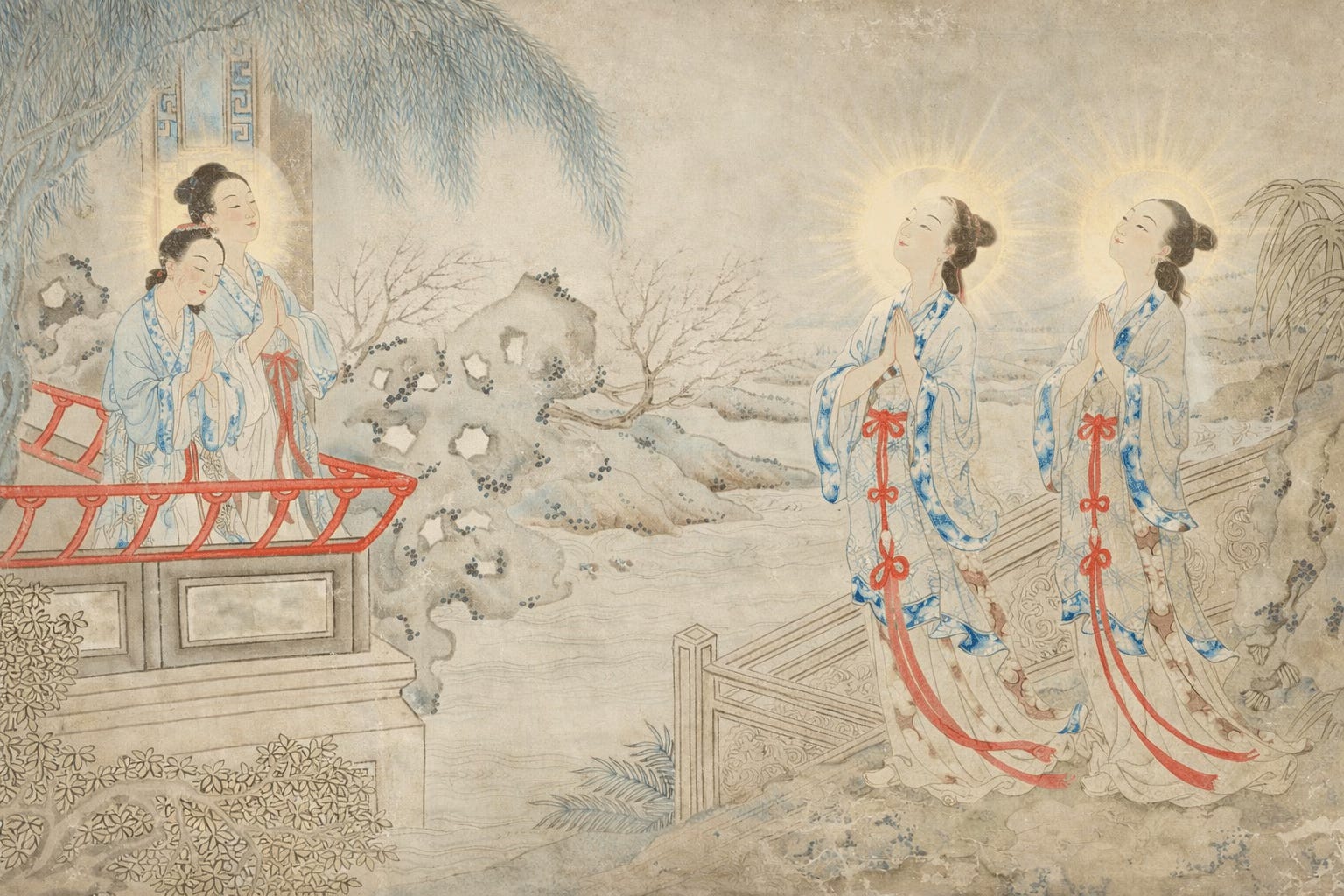
The Secret of the Golden Flower (originally titled Das Geheimnis der goldenen Blütein German) is centered around Carl Jung’s profound commentary on the Daoist classic of the same name. Jung explores core Daoist ideas—such as the “Dao” and “the circulation of light”—and brings them into dialogue with psychology, revealing their relevance to personal growth and the inner world.
In this work, Jung examines the dynamic between consciousness and the unconscious, suggesting that Eastern and Western thought can together help mend a divided psyche. He carefully engages with the translation by the German sinologist Richard Wilhelm, and by drawing parallels to European mandala symbolism, he illuminates how Eastern philosophy has deeply shaped the West’s understanding of the unconscious.
Are the obstacles to enlightenment the same for men and women?
Yes, but the emphasis differs. Generally speaking, women are more inclined to feel, to enter their inner body, and thus they naturally abide closer to Being and are nearer to the state of enlightenment. This is why many ancient cultures instinctively favored feminine figures or metaphors to represent or describe the formless, transcendent reality.
In the Tao Te Ching, one of the oldest and most profound books ever written, the “Tao” (which can be translated as “Being”) is described as “the mother of heaven and earth.” By nature, women are closer to Being than men because they actually embody this unmanifested state. Furthermore, all things eventually return to their source. “All things vanish into the Tao, and exist within it.” Since the source is seen as feminine, in psychology and mythology the feminine represents both the primordial darkness and the light—the Goddess or Divine Mother has two aspects: she gives life, and she takes it back.
When the mind becomes dominant, human beings lose connection with their divine essence, and they begin to perceive God as a masculine figure. Society becomes male-dominated, and women become subservient to men.
Some people today replace the word “God” with “Goddess.” They are rebalancing what has long been lost between the masculine and feminine, which is good. But it is still a representation, a concept—perhaps useful temporarily, like a map or a signpost—yet it can become a hindrance rather than a help once you have recognized the reality beyond all concepts and images. The truth is, the energy frequency of the mind seems inherently masculine. The mind likes to resist, to fight for control, to dominate, manipulate, attack, control, and possess. In fact, “God” is the mind’s own image of itself.
To transcend the mind and reconnect with the reality of Being, we need different qualities: surrender, non-judgment, acceptance of life rather than resistance, a gentle embrace of all things. All these qualities are closer to the feminine principle. Mental energy is solid and rigid; the energy of Essence is soft and yielding, yet ultimately, the energy of Essence is more powerful than mental energy. The mind rules our civilization, but Essence governs all life on earth—and beyond. Essence is highly intelligent; its physical manifestation is our material world. Although women are instinctively closer to Essence, men too can access it within themselves.
Today, the majority of both men and women are still controlled by their minds: identified with the thinker and the pain-body. This is certainly an obstacle to enlightenment and the blossoming of true love. A general rule is that the biggest obstacle for men is the mind, while for women it is the pain-body—though in rare individual cases, the opposite may be true, or both may be equal.
It is true that over thousands of years, a large part of women’s collective pain-body has resulted from violence inflicted by men. But if their sense of self derives from this fact and traps them in a collective victim identity, they are mistaken. If a woman holds onto anger, hatred, or condemnation, she holds onto her pain-body. This may give her a comforting sense of identity and solidarity with other women, but it keeps her trapped in the past and prevents her from accessing her essence and attaining true power in the now. If women reject men, this fosters a sense of isolation and strengthens the ego. The stronger the ego, the further you are from your true nature.
Therefore, do not use the pain-body to give you an identity; instead, use it as a tool for enlightenment by transforming it into consciousness. The best time for this transformation is during menstruation. I believe that in the coming years, many women will enter full consciousness during their menstrual cycle. Often, because many women are controlled by their collective feminine pain-body during this time, it becomes a period of unconsciousness. However, once you attain a certain level of awareness, you can change this and become more conscious rather than unconscious.