

Who Decides What Is Real?
Narratives, Power, and the Hidden Grammar of Modern Civilization
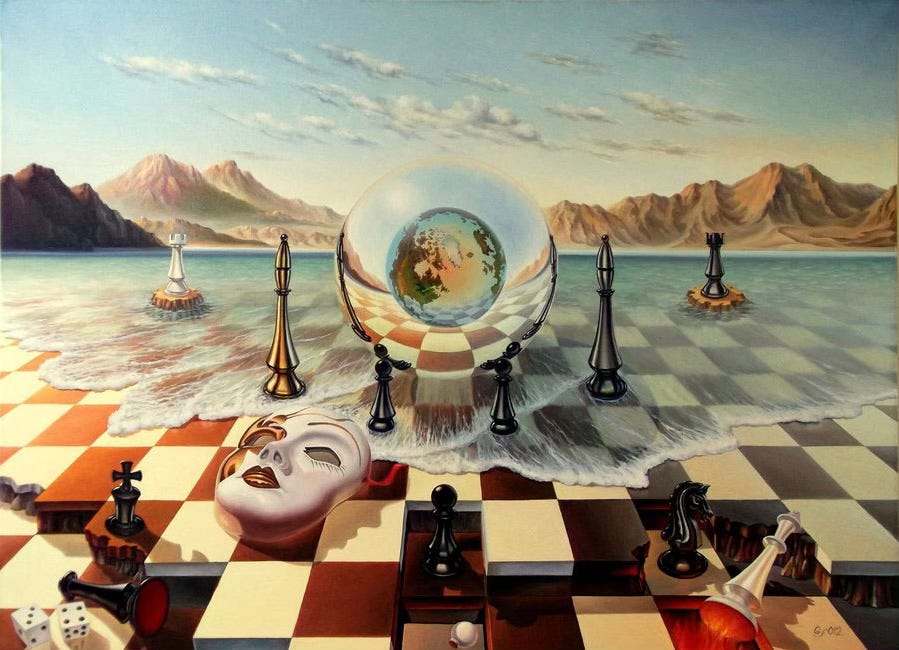
The world is not as solid as it appears. Beneath the order we take for granted lies a deeper truth: reality itself is malleable, and true power stems from the hidden control of this malleability.
A select few understand and operationalize this principle. They function as master narrators and institutional engineers, crafting the dominant stories that frame our collective experience. Through complex, often unspoken alliances, they construct the foundational frameworks of society—our economic systems, political ideologies, and cultural norms. This precise apparatus—what we call society, the market, or civilization—functions as a stable track of interests, ensuring the continuity of its creators’ authority.
The majority, however, live within this constructed landscape. A sophisticated, sustained conditioning operates through various channels: belief systems that outsource agency to higher powers; consumer cultures that replace purpose with perpetual wanting; and entertainment ecosystems that drown deep reflection in a sea of shallow stimulus. The outcome is a pervasive, quiet hypnosis.
The essence of power is the monopoly on definition. It is the technical capacity to determine which events are significant, which histories are authoritative, and which futures are conceivable. The education system filters knowledge, the media modulates information streams, and cultural institutions sanctify certain dreams. Immersed in this environment, the public gradually absorbs a manufactured consensus, internalizing it as the natural order. They learn to operate within a given grammatical structure of society without questioning its syntax.
This is a dynamic art of governance. The surface narratives evolve expertly with the times: medieval authority was wrapped in divine sanction; modern power appealed to nation and reason; future authority is concealed within the glow of algorithms and data. Each transformation resembles an elegant system upgrade. The surface narratives change continuously, yet the underlying grammar of power is replicated and passed down like hidden genetic code. They create issues, steer conflicts, and offer solutions at opportune moments, always keeping the rules of the game firmly in their own hands.
The most profound truth of this game might be this: What matters is never what the “truth” is, but what shape “reality” is molded into. When a story achieves critical mass of belief, it acquires concrete force—it moves markets, justifies wars, and defines social values. The ultimate prize is not the possession of facts, but the authority to perform this alchemy of perception.
Awareness begins with a simple, disruptive act: questioning the source of the narrative. It is the realization that one has a choice beyond merely consuming stories or optimizing one’s position within a given script. To recognize the malleability of reality is to reclaim a fundamental agency. It is to understand that every reader of the world’s script holds the latent, and irrevocable, potential to become its editor.