

When Money Became God
How Control, Efficiency, and Capital Quietly Replaced Lived Reality
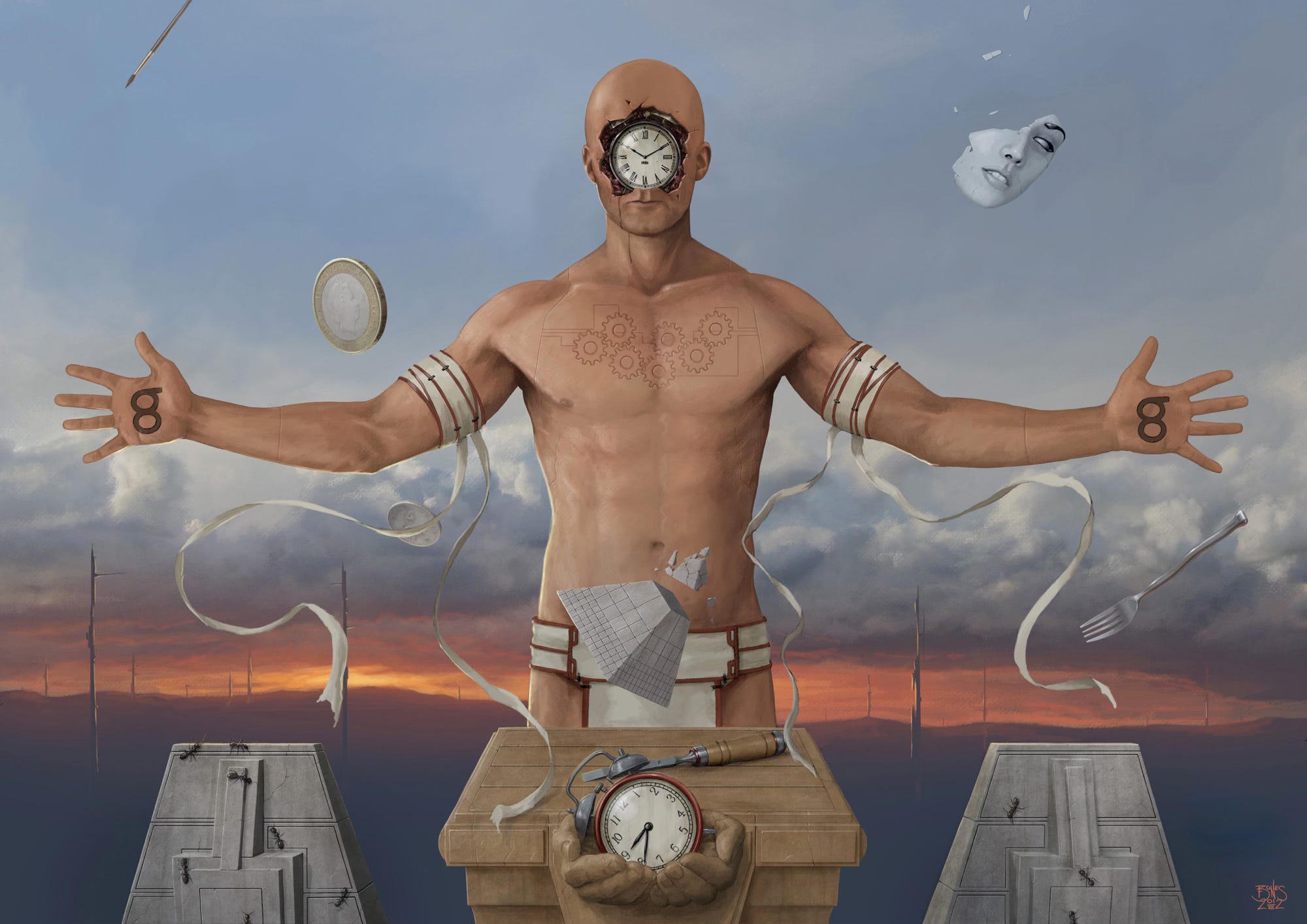
Modern society often defines itself as the pinnacle of rationality and progress. This self-perception may be built upon a series of unexamined collective illusions. These illusions are not mere accidental errors but constitute the core pillars of the modern order of existence—shaping behavior, defining values, and potentially eroding the authenticity of life at its deepest levels.
The so-called process of civilization is often equated with the construction of cities, institutions, and technology. However, its underlying logic can be interpreted as an ever-expanding desire for control—the domestication of nature, the discipline of the body, and the systematic neglect of inward spirituality. The towering edifice of civilization may not be built upon the foundations of enlightenment but upon an ever-deepening rupture from the source of life.
Time is not a purely neutral dimension. Since the invention of the mechanical clock, time has gradually been abstracted, standardized, and transformed into a core instrument through which power structures organize society and quantify life. From factory schedules to digital-era calendar management, the worship of efficiency comes at the cost of direct experience of the present. Life is segmented into manageable units, anxiety fuels this intricate system, and a genuine sense of existence quietly dissipates in the chase for the future’s moving hands.
The modern education system often prides itself as a cradle for nurturing talent. Yet, in practice, it often prioritizes training in compliance and replication rather than inspiring inquiry into the essence of self. Creativity is reduced to quantifiable achievements, and unique souls are pressed into molds of standardized answers. This process resembles a systematic training in forgetting—making one forget the innate intuition, curiosity, and inner wisdom to be more smoothly integrated into predefined social gears.
Despite unprecedented advancements in communication technology, genuine connection of consciousness seems increasingly scarce. The vast amounts of speech, text, and digital content essentially constitute a one-way projection of information, aimed at affirming one’s own stance, reinforcing biases, or persuading others. Society has never lacked discourse, but it may always lack the sincere encounters that lead to unifying understanding.
In an era proclaimed as secular, a new belief system has quietly taken the dominant position: capital. Money has transcended its neutrality as a medium of exchange and has been endowed with an almost sacred, omnipotent quality. It invisibly adjudicates value, determines opportunities for survival, and shapes social structures. In service to this “new deity,” health, human relationships, personal ideals, the ecological environment, and even the future of generations to come are often tacitly accepted as sacrifices.
To examine these “core illusions” is itself an act of lucid rebellion. It compels us to ask: Beyond control, efficiency, standardization, superficial communication, and the logic of capital, are there other ways to organize society, experience time, educate one another, and connect with life? The question itself is already the beginning of the exploration.