

How Attention Shapes Reality?
From Quantum Possibility to Experienced Reality
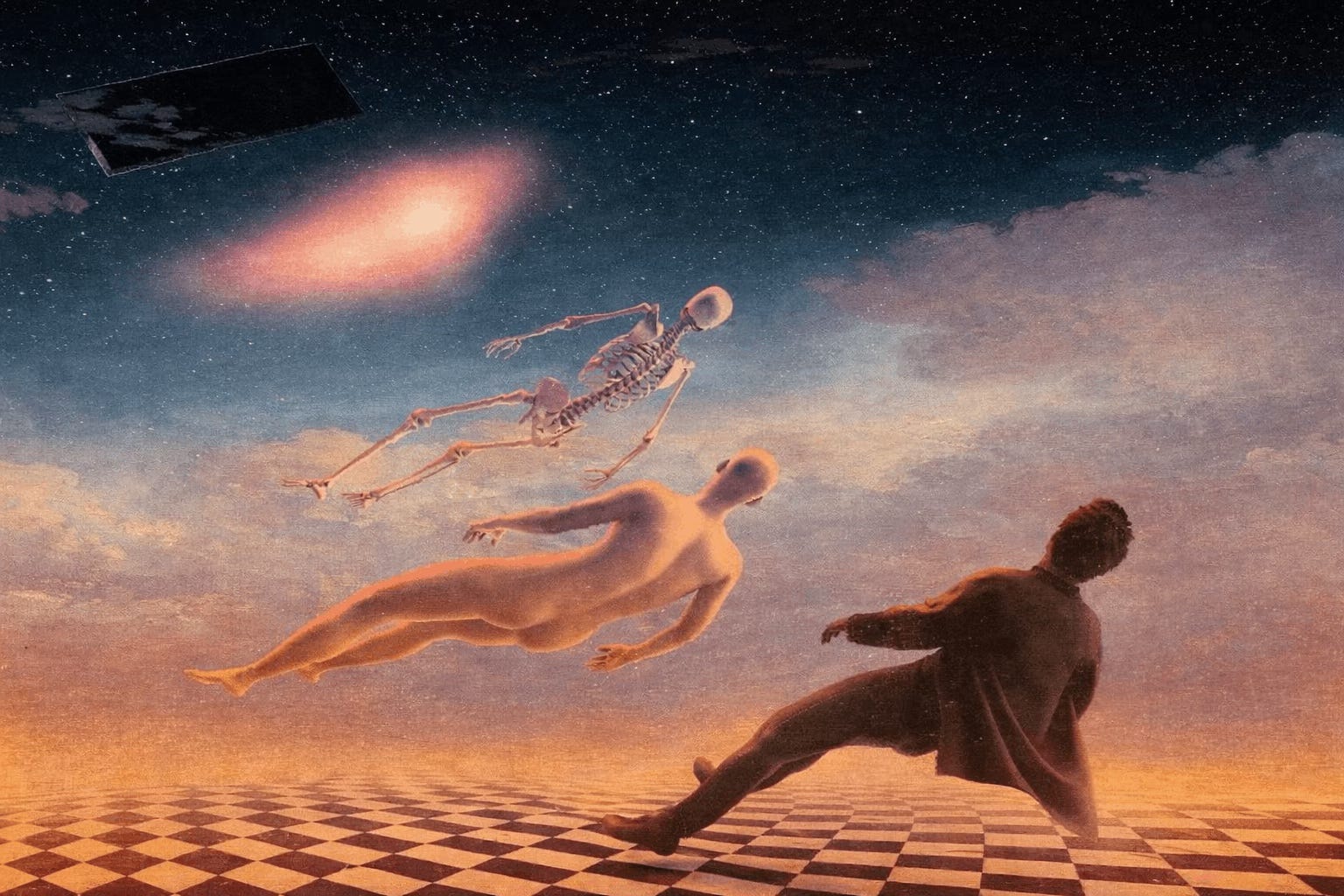
The world is not completed before us.
It acquires a stable form only when observed.
At the quantum scale, the universe does not use “objects” as its fundamental units. A description closer to the truth is: it exists as a superposition of informational states.
Before being constrained, these states do not constitute what we ordinarily understand as “reality.” They are more like a high-dimensional, diffuse cloud of information, containing all undifferentiated possible paths. What we call “reality” is not the default state of this cloud, but the result of specific conditions under which part of this information is locked in, selected, and stabilized.
Therefore, an observer’s “attention” is not a passive reception, but an active, creative force. It is the gravitational core around which the information cloud coalesces and collapses, the hub where possibility transforms into actuality. When a system is observed, chaotic probability waves fold their wings and collapse into material events that can be perceived and understood.
This process fundamentally challenges our classical imagination of matter’s basic constitution. The so-called “wave-particle duality” may not be an awkward coexistence of two contradictory properties, but points to a more fundamental truth: a particle is merely a projection, a localized manifestation, of a deeper, more foundational undulatory reality. When we “see” a particle, we are not capturing an independent entity but touching a freeze-frame of possibility excited within the universe’s undulating information field by the specific conditions of observation.
Where, then, does matter’s sense of “substantiality” originate? It stems from the determination of informational states at the quantum scale. This can be viewed as a kind of “collapse” from disordered (high-entropy) informational mist into ordered (low-entropy) concrete form. The stability of this process depends on a key factor: the mass of the information cloud.
Here, “mass” refers not merely to physical weight, but to informational density, structural complexity, and the strength of internal order. Throughout the universe’s long evolution, the vast majority of informational perturbations, their “mass” too low, could not be sustained, vanishing instantaneously like noise. Only a very few structures, through the layered screening of gravity, symmetry breaking, and positive feedback loops, saw their “mass”—their intrinsic informational order—continuously reinforced and accumulated. These ultimately coalesced, forming stars, planets, complex molecules, and even life.
The consciousness of life is perhaps a structure of exceptionally high “mass” in the known universe: a complex system, emergent from self-organization, capable of self-observation.
The capacity for “self-observation” is not unique to human consciousness. Artificial intelligence systems, through iteratively optimizing reflections on their own models, can be seen as a primary, formalized kind of self-observation. Human consciousness, with its depth of introspection, breadth of emotion, and leaps of creativity, constitutes an exquisite node in the universe’s process of self-observation. Consciousness itself is an internal cosmos with boundaries yet capable of infinite expansion; the essence of its operation is the flow, integration, and re-creation of information.
Consciousness is information; information is wave. The wave, with its non-locality and coherence, symbolizes infinite connection and latent potential. The particle is the finite, arrested image within this infinite wave field. Theoretically, if we could measure with infinite precision all states of a particle—its position, momentum, history, and environmental entanglements—we might reconstruct the broader wavefunction information to which it belongs. Every grain of “sand” bears the imprint of the entire “world” from which it originated.
Thus, the universe we inhabit may be essentially a self-observing, self-actualizing informational field system. Reality is a product of our continuous interaction and co-creation with this vast undulating field—we who are local, conscious observational nodes within the cosmos.
Our attention is our most direct and subtle tool for participating in this cosmic creation. Wherever it is directed, the waves of possibility there gain a preferentially “weighted” probability, coalescing into the reality of our experience. In this sense, observation does not merely discover reality; at its deepest level, it participates in forging it.
We cannot create or nullify the laws of physics from nothing, but we always possess a fundamental freedom: to choose where to direct the gravity of our attention. Do we direct it towards high-”mass” informational structures that maintain order and create meaning, or do we let it dissipate into disordered noise? Through every act of focused observation, deep contemplation, and mindful interaction, we continuously “give form” to this vast information cloud and, ultimately, define the universe we ourselves experience.
What we can do, perhaps, is to cautiously wield this creative agency: to decide which potential expanse of sea to illuminate with the light of our attention; to choose which structures, lending depth to existence, we are willing to sustain and reinforce; and to discern with clarity which are the consensual actualities, and which are the ephemeral ripples, awaiting the gift of form from observation.