

Why Inner Peace Begins When Distractions End?
Order, Attention, and the Architecture of the Mind
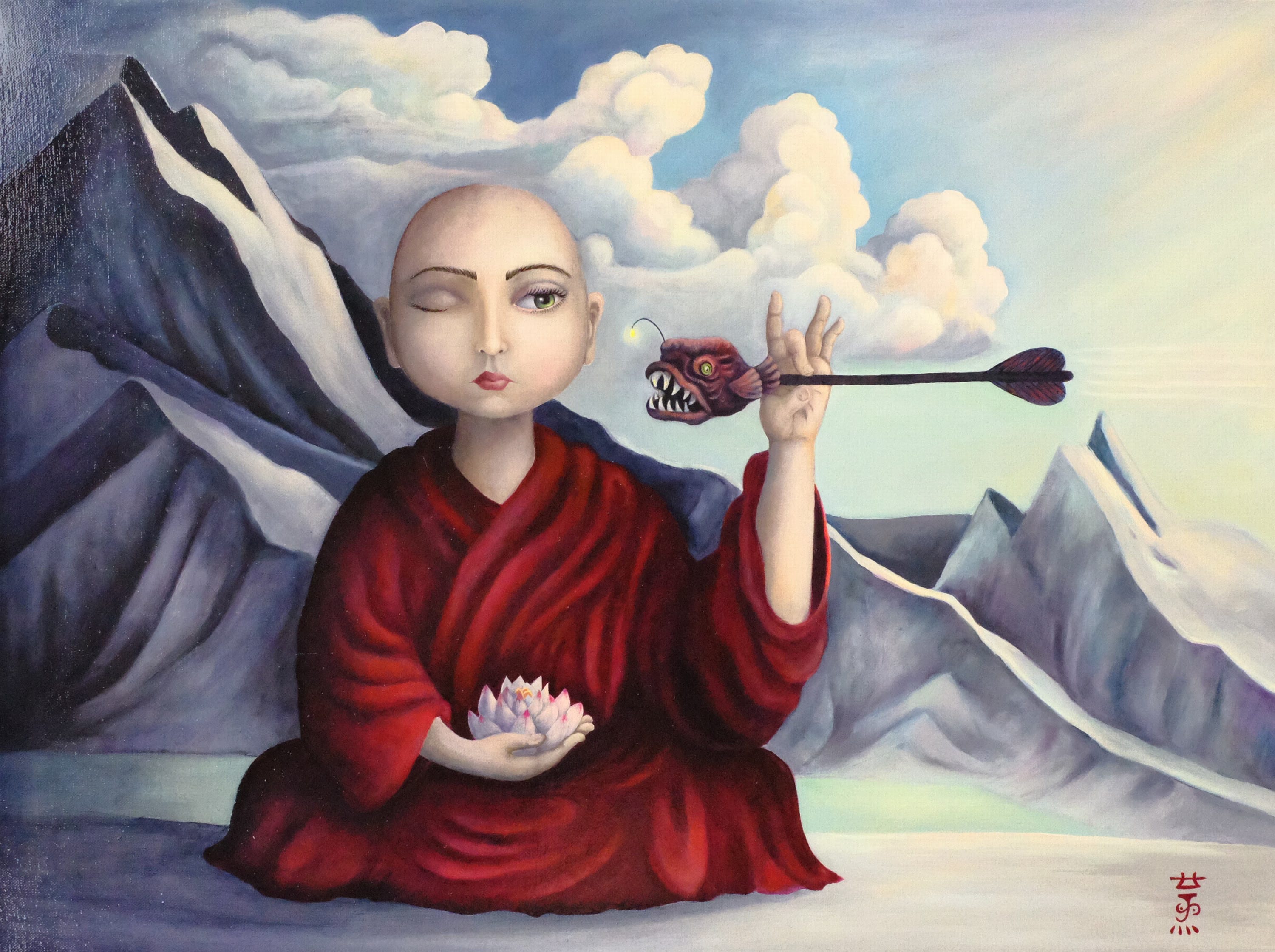
What keeps us from achieving inner peace are external distractions. When all temptations are eliminated, it is as if scattered points of disorder are drawn back into the self, where our energy reconverges and erupts into order. A stable state is, in essence, an ordered state.
The idea that “inner restlessness stems from external things” resonates with many philosophical and spiritual traditions—such as the Buddhist concept of “attachment,” the Daoist principle of “non-action,” and the Stoic notion of the “inner citadel.” When we overly identify with external things—wealth, evaluations, relationships—our consciousness becomes “scattered outward,” and our energy dissipates in pursuit, anxiety, or dependency. The essence of “eliminating temptation” is not to escape the world, but to redirect our attention through awareness—from “external identification” back to “inner subjectivity.” This is like focusing scattered light into a laser beam: energy transitions from chaos to order.
The notion that “disordered points return to the self, and energy reconverges into order” corresponds precisely to the principles of thermodynamics and self-organization theory. From a cosmic perspective, after the Big Bang, the universe gradually formed ordered structures like galaxies and planets from an intensely hot, uniform “chaos” (high entropy)—a process driven by gravitational forces and natural laws. From a psychological perspective, when our thoughts are scattered by external distractions, mental entropy increases, manifesting as restlessness and confusion. Through focus, meditation, or value realignment, consciousness forms a kind of “psychological gravity” that integrates fragmented thoughts, leading to clarity, creativity, and inner peace (mental entropy reduction). This reveals a fundamental law: order requires boundaries and focus—whether in the formation of celestial bodies or the growth of the mind.
“A stable state is an ordered state.” True “inner order” is not rigidity but resembles a gyroscope—externally, it may appear to spin (responding to the world), while its central axis remains steadfast. In this state, energy is not wasted internally but flows efficiently toward creative action.
Buddhism teaches that “when the mind abides nowhere, its true nature arises.” When we cease clinging to external phenomena, innate wisdom and compassion naturally manifest. Daoism advocates “emptying the mind to the utmost and maintaining deep tranquility.” As all things flourish, we observe their return—in profound stillness, we perceive the fundamental laws governing the world’s workings. In modern psychology, the state of “flow” exemplifies inner order—when attention is fully immersed in a goal, the sense of self dissolves, and action unfolds spontaneously, like the universe expressing itself.
Achieving a higher order by “eliminating temptation” does not mean isolating oneself from the world. Rather, it is about coexisting with all things without being disturbed by them. In this state, the external world no longer scatters energy as temptation but becomes an opportunity to reflect inner order.
Whether in cosmic evolution, the growth of life, or the progression of consciousness, all follow the path from “scattering to focusing, from chaos to order.” “Inner stillness” serves as the switch that initiates this process—when the mind ceases to chase outward, the inner universe spontaneously reorganizes, unleashing immense creativity and tranquility. Through insight into the shared rhythm of life and the cosmos, you will discover that you are the creator of order.